
Winter Vibes in Austria: Between Christmas Market Anticipation and the Winter Blues
The Christmas season is just around the corner—and Austrians are looking forward to it! But what is the cold and dark season really like?
A Large Majority Plans to Visit Christmas Markets
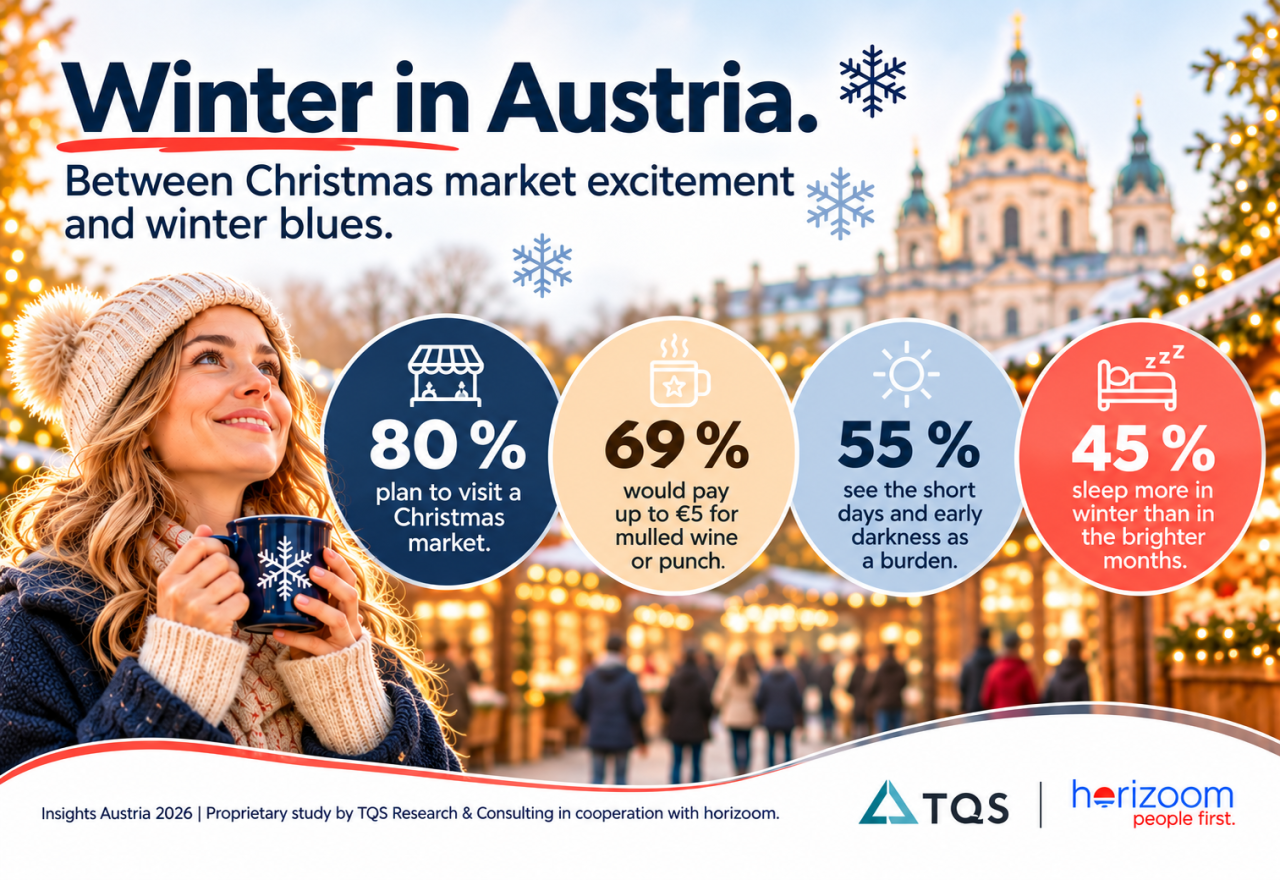
Christmas markets continue to enjoy great popularity in Austria: 80% of those surveyed plan to visit a Christmas market during Advent—48% definitely will, and another 32% probably will. Anticipation is particularly high among young people: Among 16- to 29-year-olds, as many as 88% plan to visit. Only one in five has no plans to visit or is unlikely to visit.
Majority Rejects Prices of 5 Euros or More for Mulled Wine or Punch
For 69% of respondents, the personal price limit for mulled wine or punch is under 5 euros, with 31% willing to pay even less than 4 euros. Only 21% would be willing to spend 5 euros or more. Another 12% state that they generally do not buy mulled wine or punch. This shows that there is a strong desire to visit Christmas markets—but only up to a certain pain threshold when it comes to drink prices.
Well-being During the Winter Months: Lack of Daylight Becomes a Burden for Many
The fall and winter months have a negative impact on the well-being of many Austrians. 36% of respondents perceive the effects as somewhat or very negative, while 24% experience the cold season positively. Another 40% perceive neither positive nor negative effects. A difference based on age is evident in the statistical analysis: as people get older, they tend to perceive the fall and winter months as having a more negative impact on their well-being.
The shortest days and early darkness are cited as the greatest source of stress (55%), followed by a lack of daylight (44%). Low temperatures (35%) and frequent bad weather (34%) also affect well-being. In addition, financial burdens play a role: 30% cite higher heating and energy costs as a negative factor.
Nearly half of Austrians sleep more in the winter
The fall and winter months also affect Austrians’ sleep patterns. 45% of respondents say they sleep more during the darker season than in the warmer, brighter months—15% even significantly more. For just under half (49%), however, the amount of sleep remains largely unchanged. Only 6% report sleeping less in the fall and winter. Striking differences emerge with regard to age and gender: While 56% of 16- to 29-year-olds sleep more in the winter, the figure is only 37% among 50- to 65-year-olds. Women also report sleeping longer significantly more often than men (50% vs. 37%). Overall, this suggests that younger people and women, in particular, adapt their sleep patterns to the darker season.
Winter Travel: Short Trips and Sun-Seeking Vacations Outnumber Ski Vacations
Currently, about one-third of Austrians (33%) are planning to travel during the coming winter season. Fourteen percent each plan to travel within Austria or abroad, while another 5% plan to take both a domestic and an international trip. The majority (59%), however, have not planned a vacation, and 8% are still undecided.
Among those who want to travel in the winter, short trips and day trips top the list at 38%. These are followed by trips to warmer, sunnier regions (31%) and visits to family, relatives, or friends (28%). Traditional ski and winter sports vacations also remain an important part of winter travel planning: 27% of those planning to travel cite this type of vacation as their preferred option. Winter vacations without winter sports—such as wellness stays or city breaks—are mentioned almost as frequently (25%). The results thus show that winter travel plans are diverse and that, in addition to traditional ski vacations, shorter getaways and trips to warmer regions in particular play an important role.
Study Profile: Insights Austria
Since 2024, TQS Research & Consulting, in collaboration with the online access panel horizoom, has been conducting a regular survey of 1,000 Austrians (and often 1,000 Germans as a comparison sample) on various socially relevant topics. The study provides up-to-date insights into public opinion—ranging from politics and the media to the world of work, financial situations, and health. For this study, n=1,000 people aged 16 to 65 in Austria were surveyed online in September 2026. The sample is representative and weighted by age, gender, region, and educational level. The survey was conducted from November 10–18, 2026, via the online access panel of horizoom GmbH.
Further details on the study, including a chart report: https://www.blog.tqs.at
About TQS Research & Consulting KG
www.tqs.at
TQS combines consulting and market research to develop customized solutions and tools for clients and to support their decision-making in order to ensure market success. TQS Research & Consulting KG was founded in 1997 following a successful FWF research project conducted by the Institute for Marketing Management at the Vienna University of Economics and Business and the Institute for Work and Organizational Psychology at the University of Vienna. For more than two decades, TQS has successfully implemented proven tools and concepts in practice and developed new methods to meet the specific needs of its clients.
About horizoom GmbH
www.horizoom.de
horizoom was founded in 2023 with the goal of creating quality, service, and genuine added value for clients as a data-driven provider of online access panels. In doing so, we think and act according to the “People First” approach: We are convinced that only fair and respectful treatment of people throughout the entire research process can lead to honest and engaged responses—and thus to valuable insights. horizoom GmbH is ISO 20252:2019 certified, owner-managed, and independent; it employs 34 people and has its headquarters in Berlin as well as a branch office in Cologne. As a member of the associations ADM, BVM, DGOF, ESOMAR, and VMÖ, horizoom is committed to complying with the recognized industry standards for market and social research, as defined by the Council of German Market Research (Rat der Deutschen Marktforschung e.V.) and the international ICC/ESOMAR Code.
[Cover image created with AI]
