
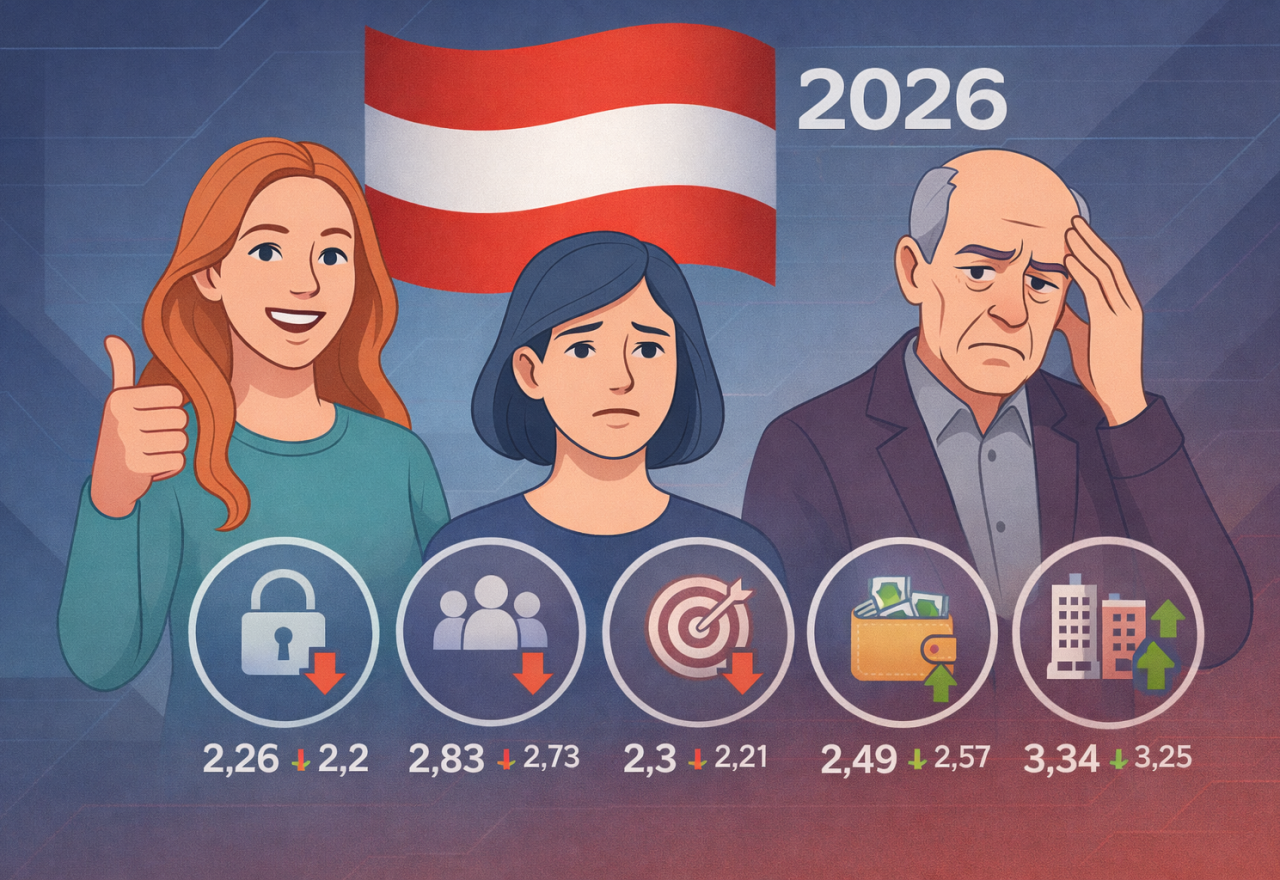
Mood in Austria remains tense – personal optimism persists
The current mood in Austria continues to be characterized by skepticism and uncertainty. Two-thirds of the population (66 percent) say they are somewhat to very negatively affected by current news, information, and social developments. Despite this critical attitude, personal outlooks remain stable and positive: 66 percent of Austrians also rate their own development and personal future prospects as somewhat to very positive. This figure remains stable compared to the fall and indicates a clear separation between individual life planning and the overall social situation.
Divided trust in the media – politics continues to suffer from a trust deficit
When it comes to trust in the media, the picture remains divided. While 55 percent of the population fundamentally trusts the media, 45 percent express little or no trust. It is particularly noteworthy that 15 percent of those surveyed do not trust the media at all. These figures have hardly changed in recent months and indicate a solidification of polarization.
The verdict on politics is even more critical. Trust in political leadership remains low. Currently, only around 25 percent of Austrians trust the government to take the right measures for the country. Although this figure is slightly above the low point of the transition phase, it is still well below a stable level of trust. Three-quarters of the population continue to have little or no trust in political leadership.
Sense of security recovering noticeably
On the other hand, the subjective sense of security has developed positively. 69 percent of those surveyed currently feel somewhat to very secure. This means that the perception of the security situation has improved significantly compared to last year. Between March and June of last year, the proportion of those who felt insecure peaked at 38 percent. The current trend points to a noticeable recovery and a stabilizing effect on the overall mood.
High loyalty to employers in uncertain times
The labor market also shows a clear picture of stability. 82 percent of working people are not currently planning to change jobs. At the same time, around one-fifth of employees remain mobile and say they want to change employers within the next twelve months.
Employer branding therefore remains a key issue for employers – both in terms of attracting new talent and retaining existing employees. Against the backdrop of financial constraints in many households, fair pay, job security, and flexible working time models, including working from home, remain the decisive criteria for an attractive employer.
Financial situation stabilizes slightly – scope remains limited
The assessment of one’s own financial situation shows a slight stabilization, but remains tense overall. Slightly more than half of the population (54 percent) rates their own financial situation as positive. At the same time, one in eight (13 percent) say they are struggling to make ends meet financially. Almost half of Austrians (49 percent) report having less money available for daily living expenses.
The picture is mixed when it comes to saving behavior: for one-third of the population, saving behavior has not changed, 22 percent are able to save more than in the previous year, while 45 percent say they are able to put less money aside. The greatest burdens continue to be felt in key areas of life such as food, energy, restaurants, and fuel. In response, more and more consumers are taking action and specifically switching providers—especially for electricity, telecommunications, internet, and insurance.
Sustainability remains relevant—skepticism about climate protection remains high
Sustainability remains an important issue in everyday life for many Austrians. 45 percent say that sustainability considerations have a noticeable influence on their consumption and mobility decisions. At the same time, skepticism about the effects of current climate protection measures remains high. 41 percent of respondents doubt that these will have a positive long-term impact on the future. Only 12 percent are optimistic about the current state of climate protection measures.
Social cohesion is declining significantly
The perception of social cohesion is developing particularly critically. The proportion of those who rate social interaction and mutual support in Austria negatively has risen significantly in recent months – from 50 percent in March to 58 percent in June and 66 percent in September to 69 percent most recently. At the same time, the proportion of positive assessments has fallen from 50 percent to just 30 percent over the same period. This development highlights increasing social polarization and growing concern about social cohesion.
Conclusion: Socially skeptical – personally confident
Overall, the mood is complex: while mistrust, cost burdens, and social tensions characterize the public climate, the majority of Austrians remain remarkably confident in their personal lives. Security, job stability, and individual plans for the future serve as central anchors in challenging times.
Further details on the study, including a chart report: https://www.blog.tqs.at
