
Insights Austria
Since 2024, TQS Research & Consulting has been conducting a regular survey of 1,000 Austrians on various socially relevant topics in collaboration with the online access panel horizoom. The study provides up-to-date insights into public sentiment—ranging from politics and the media to the workplace, financial situation, and health. In this survey, for the first time, 1,000 Germans were surveyed alongside the traditional survey of Austrians to enable a cross-country comparison in addition to the Austrian trend analysis.
2026 World Cup – Moderate Interest in Austria and Germany – Spain Will Be World Champion!
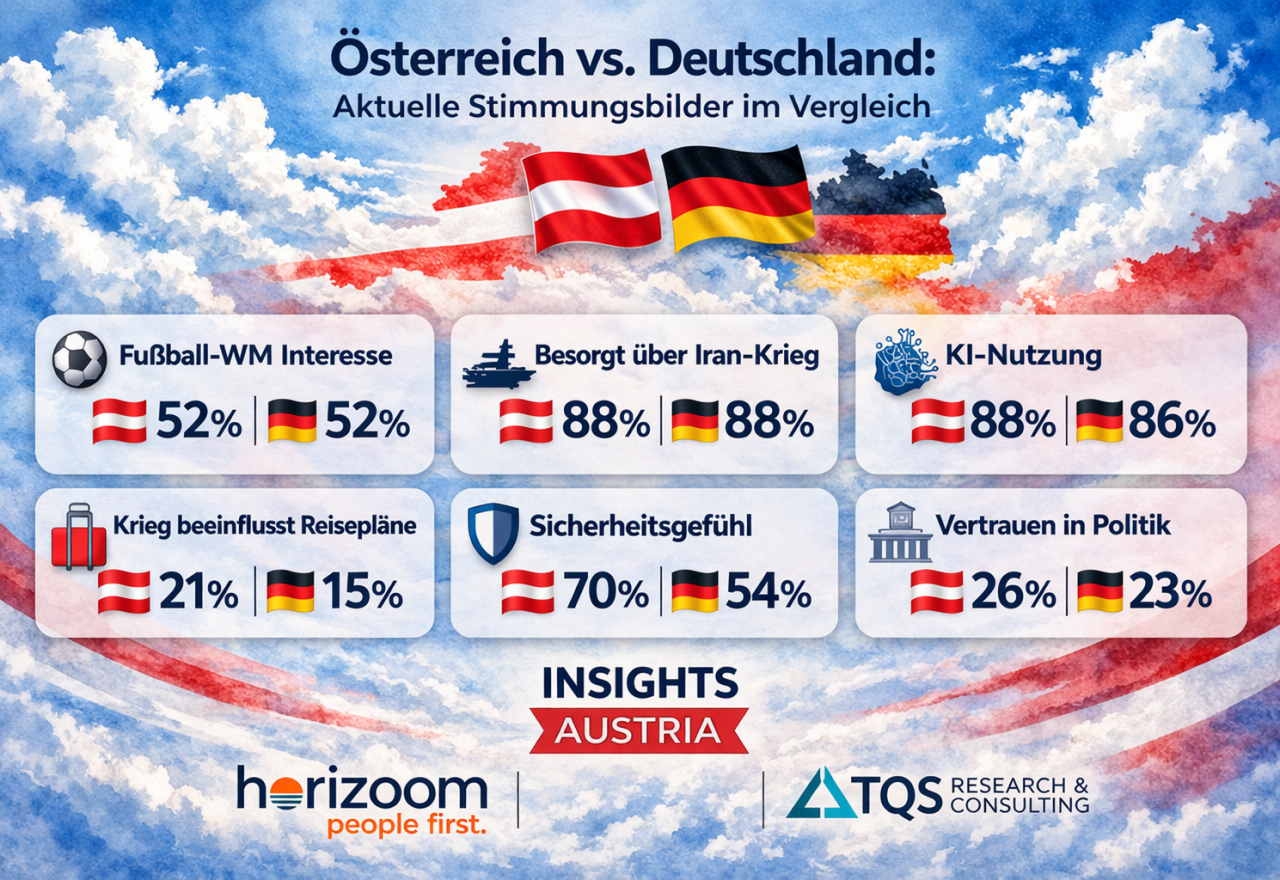
Less than three months before the start of the 2026 World Cup, just under a third of respondents in Austria (31%) and Germany (31%) say they have great or very great interest in the sporting event (Top Box 1-2). Another third still needs to be convinced, while the rest (AUT 33%, GER 28%) say they already know they definitely won’t be following the event, and there is even agreement that it is unimportant for their own country (32%). No plans to attend the games in person in the U.S., Canada, or Mexico! The majority in both countries say they want to watch the World Cup at home on TV (53% in Austria, 50% in Germany). 19% of Austrians want to watch the World Cup at public viewings, while 14% of Germans do.
4 Weeks of War in the Middle East – Major Concern in Germany and Austria
The vast majority—about 9 out of 10 residents—in Germany and Austria are concerned about developments in Iran and the region. Only about 12% in both countries appear unimpressed and are not worried.
The primary responsibility for the conflict is viewed similarly in Germany and Austria: About 40% in both countries see several countries as equally responsible for the conflict. The U.S. is cited in second place by 28% (AT) and 26% (DE). Iran and Israel are cited as primarily responsible by about one in ten.
People in Austria and Germany tend not to view military attacks against Iran as justified; a majority does not believe military strikes will lead to a long-term solution:
Polarized views on attacks: In Germany, 28% view military attacks against Iran as somewhat or very justified, while in Austria, 25% share this view. 27% of Austrians and Germans are unable to provide an answer. This reflects a polarizing issue, albeit with a tendency toward the view that the attacks are not justified.
In contrast, three-quarters of Austrians and Germans clearly answer “no” to the question of whether they believe military measures can resolve the conflict in the long term. Only 8% (AT) and 9% (DE), respectively, consider military measures to be a long-term solution.
As for the consequences of the conflict, the concerns of Austrians and Germans are nearly identical. For about 75%, rising energy prices—such as the price of oil—are the greatest concern, closely followed by worries about inflation and the economic consequences for Europe and for Austria/Germany (71% each). A solid 60% in both countries are concerned about a larger international war as well as an increased risk of terrorism in Europe as a result of the conflicts in the Middle East. Fear of refugee movements from the region is cited as the sixth-biggest concern in Austria (54%) and the seventh-biggest in Germany (50%).
Impact of the War on Travel Plans: Among respondents, Germans and Austrians differ regarding the extent to which the conflict is limiting their travel plans. When asked whether the current war in the Middle East is influencing their travel plans for 2026, 15% of Germans state that they have been very strongly or somewhat strongly influenced, compared to 21% of Austrians. However, more than 60% in both countries state that their travel behavior has not been influenced at all or only slightly this year.
Regarding future travel behavior, approximately half of the Germans surveyed state that political conflicts will have a somewhat strong or very strong influence; among the Austrians surveyed, this figure is nearly 60%.
Regarding future travel behavior, about half of the Germans surveyed state that political conflicts will have a somewhat strong or very strong influence; among the Austrians surveyed, the figure is even just under 60%.
The 2026 Eurovision Song Contest in Austria – room for growth in enthusiasm, controversial participating countries
Currently, 44% of Austrians say they view the 2026 Eurovision Song Contest in Vienna either very positively or somewhat positively, while 38% view it somewhat negatively or very negatively; the rest have no opinion. The results are similarly mixed when asked whether the Eurovision Song Contest is economically worthwhile for Austria: 46% say “very” or “somewhat,” while a narrow majority (53%) express skepticism on this point.
Little interest in attending in person – Just 5% say they are either “somewhat likely” or “very likely” to attend.
Polarizing Participating Countries: Israel and Russia: We asked Austrians how they feel about the participation or exclusion of the candidates from Israel and Russia. Currently, 33% of Austrians support excluding Israel from the ESC. In contrast, 31% oppose such an exclusion. 36% are undecided. The picture is similar regarding the question of Russia’s exclusion, albeit somewhat less polarized. 47% of Austrians support the current decision that Russia is not allowed to participate in the ESC, while 26% are in favor of lifting the exclusion. 28% do not take a clear position.
AI usage continues to gain momentum
Nearly half of Austrians and Germans report using AI applications several times a week to daily, indicating that AI has been integrated into the daily lives of large segments of the population. In contrast, only 12% of Austrians and 14% of Germans say they never use AI-based applications.
When it comes to trust in AI, opinions are clearly divided in both countries. Just over 50% trust AI-powered applications “somewhat” to “very much,” while the other half of the population expresses skepticism.
Positive impact on daily life prevails: The largest share of Austrians (42%) and Germans (43%) say they perceive the impact of AI as “neutral.” 35% in Austria and 37% in Germany speak of a positive impact of AI on daily life.
AI usage will continue to increase: More than half of Austrians and Germans believe they will use AI applications somewhat to much more frequently in the future (59% in AT, 54% in DE). Only one-tenth of the population does not plan to use AI in the future.
Trust in media and politics similarly mixed in Austria and Germany:
The majority of the Austrian and German populations trust the MEDIA (54% in AT and 58% in DE). Only 26% in Austria and 23% in Germany trust POLITICS or the federal government. 74% of Austrians and 77% of Germans state that they tend not to trust politics at all.
Austrians feel safer
When it comes to safety, the Austrian and German populations differ significantly. 70% of Austrians say they feel safe to very safe, while just over half of Germans (54%) say the same about themselves.
Measures regarding fuel prices offer little hope
The measures adopted by the federal government to cap fuel prices are met with significant skepticism among the population. A clear majority of 84 percent consider the interventions to be somewhat ineffective or completely ineffective, while only 16 percent attribute some effect to them. Particularly striking is the high proportion of 48 percent who rate the measures as completely ineffective. The average rating of 3.29 on a scale from 1 (“very effective”) to 4 (“not at all effective”) underscores this critical stance. Overall, this paints a clear picture: the general public largely does not view the current measures as suitable for effectively capping fuel prices.
Top price drivers are food, fuel, and energy
Current trends in inflation perception show that rising prices in key areas of daily life are clearly felt in both Austria and Germany—with fuels as one of the most significant drivers. In Austria, the proportion of those who are particularly aware of rising gasoline and diesel prices has risen sharply from 44 to 75 % since December 2025. In Germany as well, this figure stands at a similarly high level of 73 %, underscoring the high relevance of fuel prices in both countries.
Furthermore, parallels and differences are evident in other spending categories as well: Food is most frequently cited as a price driver in both countries (85% in Austria, 84% in Germany) and thus clearly tops the list. Perceptions regarding energy (electricity, gas, heating) are also comparably high (60% in Austria, 62% in Germany). Differences, however, emerge in specific service sectors: For example, the restaurant industry is perceived as a greater driver of inflation in Austria (57% vs. 52%), while in Germany, personal services (37% vs. 31%) as well as repairs and skilled trades (35% vs. 30%) are cited slightly more frequently.
Overall, a largely similar inflation pattern emerges in both countries, with slight deviations in individual sectors. However, the dynamic development of fuel prices in Austria and their overall high relevance to the perception of inflation in both countries remains particularly striking.
Further details on the study, including a chart report: https://www.blog.tqs.at
About TQS Research & Consulting KG
www.tqs.at
TQS combines consulting and market research to develop tailored solutions and tools for clients and support their decisions to succeed in the market. TQS Research & Consulting KG was founded in 1997 following a successful FWF research project conducted by the Institute for Marketing Management at the Vienna University of Economics and Business and the Institute for Work and Organizational Psychology at the University of Vienna. For more than two decades, TQS has successfully implemented proven tools and concepts in practice and developed new methods to address clients’ specific needs.
About horizoom GmbH
www.horizoom.de
horizoom was founded in 2023 with the goal of creating quality, service, and genuine added value for clients as a data-driven online access panel provider. In doing so, we think and act with a “people first” approach: We are convinced that only fair, respectful treatment of people throughout the entire research process can lead to honest and engaged responses—and thus valuable insights. horizoom GmbH is ISO 20252:2019 certified, owner-managed and independent with currently 34 employees, and has its headquarters in Berlin as well as an additional office in Cologne. As a member of the associations ADM, BVM, DGOF, ESOMAR, and VMÖ, horizoom is committed to adhering to the recognized industry standards of the market and social research profession as set by the German Market Research Council (Rat der Deutschen Marktforschung e.V.) and the international ICC/ESOMAR Code.
[Cover image created with AI]
