
Sentiment Remains Subdued
In September, sentiment in Austria remains tense: Current news and developments are weighing heavily on the population and are perceived emotionally negatively by a clear majority. 70% of respondents say they are somewhat or very negatively affected by them—a slight increase from June (68%). In contrast, only 18% view current developments as personally or emotionally positive, and the share of those affected very positively remains extremely low at 2%. At the same time, the group of those who do not feel affected or who are indifferent to these developments has declined from 14% in June to 12% currently. While trust in the media has risen slightly to 53% and shows a slight improvement compared to June, trust in Austrian politics remains at a very low level: Only 23% trust politicians or the federal government “very much” or “somewhat,” while 77% “somewhat” or “not at all” trust them.
Sense of Security in Austria Remains Stable
The sense of security in Austria remains at a stable, high level in September. 70% of respondents currently feel very or somewhat safe—a slight increase compared to June (67%). At the same time, the proportion of those who feel somewhat or very unsafe has declined from 33% to 31%. The average score improved slightly from 2.25 to 2.23 and thus remains at a consistently positive level.
Austrians’ financial situation remains strained
Austrians’ financial situation remained virtually unchanged in September and continues to be strained. 49% rate their personal situation as very good or good, while 52% describe their financial situation as strained or difficult. Compared to June, there have been only minimal shifts: The share of people who are financially satisfied rose slightly from 48% to 49%, while 15% now report having difficulty making ends meet.
Price Increases: Gas and Public Transportation Tickets Noticeably More Expensive Than in June
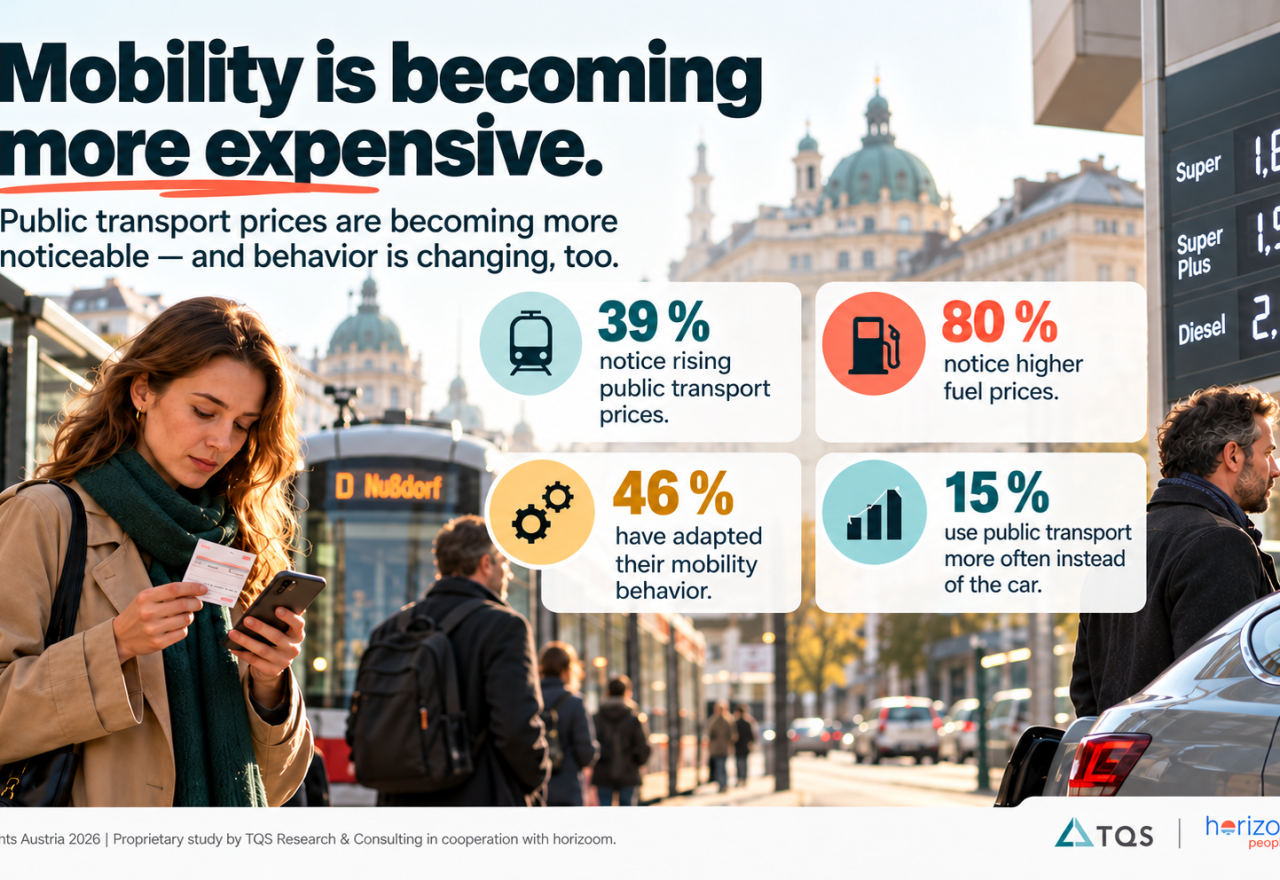
For Austrians, rising prices remain most noticeable for everyday necessities. Food continues to be cited most frequently, although the percentage has declined slightly from 88% in June to 85%. At the same time, there has been a significant increase in fuel prices: 80% currently feel the impact of rising prices for gasoline and diesel, up from 74% in June. Electricity, gas, and heating are also mentioned slightly more often (63% vs. 60%). The trend in public transportation is particularly striking: here, the proportion rose from 32% in June to 39% in September, meaning that price increases for trains, buses, Klimaticket, and similar services are becoming more prominent in the public consciousness.
Consequences for Mobility Behavior
Mobility costs are thus coming more sharply into focus as a factor in inflation—and are already having an impact on behavior: 46% of Austrians report having adjusted their mobility habits due to fuel prices. Of these, 15% are shifting their travel more significantly from cars to public transportation. Another 31% are driving less, but are not increasingly replacing those trips with bus, train, or other forms of public transportation. For 44%, mobility behavior remains unchanged.
Key Findings
Overall, the mood in Austria remains subdued and tense in September. A clear majority continues to perceive current news and developments with negative emotions, while positive reactions are limited to a minority. When it comes to trust, the picture is mixed: trust in the media has improved slightly, while trust in politics remains at a very low level. The sense of security provides a positive counterexample here: 70% of Austrians continue to feel very or somewhat safe. The population’s financial situation remains noticeably strained: rising prices continue to weigh heavily on Austrians. Price increases are particularly noticeable for food and energy; at the same time, transportation costs—especially for public transit—are coming more into focus. The fact that nearly one in two people has adjusted their travel habits due to fuel prices shows that the perceived financial burdens
are increasingly having concrete effects on everyday life.
Study Profile: Insights Austria
Since 2024, TQS Research & Consulting, in collaboration with the online access panel horizoom, has been conducting a regular survey of 1,000 Austrians (and often 1,000 Germans as a comparison sample) on various socially relevant topics. The study provides up-to-date insights into public opinion—ranging from politics and the media to the world of work, financial situations, and health. For this study, n=1,000 people aged 16 to 65 in Austria were surveyed online in September 2026. The sample is representative and weighted by age, gender, region, and educational level. The survey was conducted from September 17 to September 22, 2026, via the online access panel of horizoom GmbH.
Further details on the study, including a chart report: https://www.blog.tqs.at
About TQS Research & Consulting KG
www.tqs.at
TQS combines consulting and market research to develop customized solutions and tools for clients and to support their decision-making in order to ensure market success. TQS Research & Consulting KG was founded in 1997 following a successful FWF research project conducted by the Institute for Marketing Management at the Vienna University of Economics and Business and the Institute for Work and Organizational Psychology at the University of Vienna. For more than two decades, TQS has successfully implemented proven tools and concepts in practice and developed new methods to meet the specific needs of its clients.
About horizoom GmbH
www.horizoom.de
horizoom was founded in 2023 with the goal of creating quality, service, and genuine added value for clients as a data-driven provider of online access panels. In doing so, we think and act according to the “People First” approach: We are convinced that only fair and respectful treatment of people throughout the entire research process can lead to honest and engaged responses—and thus to valuable insights. horizoom GmbH is ISO 20252:2019 certified, owner-managed, and independent; it employs 34 people and has its headquarters in Berlin as well as a branch office in Cologne. As a member of the associations ADM, BVM, DGOF, ESOMAR, and VMÖ, horizoom is committed to complying with the recognized industry standards for market and social research, as established by the Council of German Market Research (Rat der Deutschen Marktforschung e.V.) and the international ICC/ESOMAR Code.
[Cover image created with AI]
