
Now that the summer months are over, the question arises as to how Austrians experienced this time and what conclusions they draw from it for their daily lives. The latest findings provide insight into how the summer was perceived and reveal the practical implications this has for their living environments.
Summer 2026 is perceived as significantly hotter
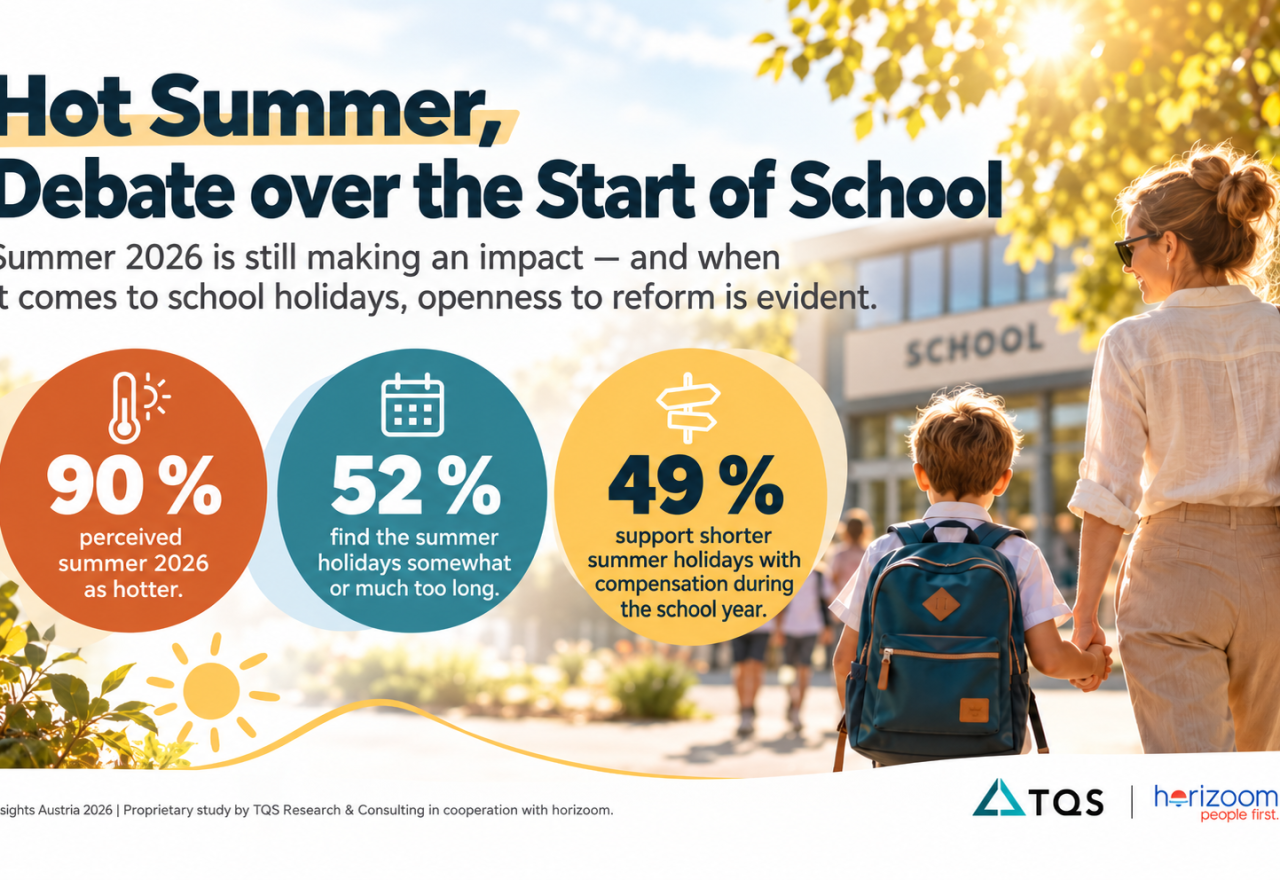
The summer of 2026 was perceived by the vast majority of Austrians as hotter than the summers of the past five years. A total of 90% perceive higher temperatures—58% even describe it as a significantly hotter summer, while another 32% describe it as a somewhat hotter summer. Only 10% perceive the temperatures as roughly the same, while cooler temperatures are hardly noticed.
Heat Protection at Home: Majority Uses Fans; Air Conditioners Are Rarely Used
When it comes to heat protection within their own homes, Austrians currently rely primarily on traditional and comparatively simple measures. The most common solutions are roller shutters, blinds, or similar shading options (70%), followed by fans (54%). Technical cooling systems are significantly less common: 17% have a portable air conditioner, 14% have a permanently installed air conditioner, and 8% have a cooling system or heat pump.
One in four plans to add heat protection
At the same time, there is significant potential for retrofitting: 23% of Austrians plan to purchase additional heat protection by next summer. 63% currently have no such plans, and 14% are still undecided. This means that about a quarter of the population is actively considering ways to better equip their homes against the heat.
Air conditioners are gaining more attention
Technical cooling solutions are clearly at the forefront of planned purchases. Among those who want to purchase additional heat protection, 52% plan to install a permanently mounted air conditioner and 35% plan to purchase a portable air conditioner. Traditional shading solutions such as roller shutters or blinds are mentioned significantly less often, at 18%.
Widespread Support for Legal Ease of Installation for Air Conditioners
The planned easing of regulations for the installation of air conditioners and other heat protection measures is meeting with widespread support in Austria. 81% of respondents strongly or somewhat support legal easing of these regulations, while only 4% oppose the proposal. This demonstrates clear public support for measures designed to facilitate heat protection in rental and owner-occupied apartments.
Start of the 2026 School Year—Summer Vacations Are Perceived as Too Long
When it comes to evaluating summer vacations, the picture is clear: 52% of respondents feel that summer vacations in Austria are much or somewhat too long. 42% consider the current length to be just right. Only a small minority—5% in total—consider the summer break to be somewhat or much too short.
Shortening the summer break with compensatory time during the school year receives relative approval
The proposal to shorten the summer break and, in exchange, provide additional days off or longer vacation periods during the rest of the school year meets with more approval than opposition. 49% strongly or somewhat support this proposal, while 31% somewhat or strongly oppose it. 19% remain neutral. This indicates a certain openness to redistributing time off from school. Among families with younger children, support is somewhat more reserved—though this difference is not statistically significant.
Clear Support for a Headscarf Ban in Schools
The introduction of a headscarf ban in schools for girls under the age of 14 is supported by a clear majority: 69% are very or somewhat in favor, 17% oppose the measure, and 14% take a neutral stance. The mean score of 1.99 underscores the overall strong support. At the same time, significant differences emerge based on political affiliation: Respondents who feel their interests are best represented by the FPÖ or ÖVP are more supportive of the measure, while support is significantly lower among those aligned with the Greens. Families with younger children are also significantly more hesitant about the headscarf ban than households without children under the age of 14.
Conclusion: Openness to Reform on School Issues
Overall, there is a noticeable openness to reform among the population regarding the start of the school year. Summer vacation is more often perceived as too long than as appropriate, and redistributing days off throughout the school year also receives relative approval. On the headscarf ban, the stance is even clearer: here, a clear majority supports its introduction.
Study Profile: Insights Austria
Since 2024, TQS Research & Consulting, in collaboration with the online access panel horizoom, has been conducting a regular survey of 1,000 Austrians (and often 1,000 Germans as a comparison sample) on various socially relevant topics. The study provides up-to-date insights into public opinion—ranging from politics and the media to the world of work, financial situations, and health. For this study, n=1,000 individuals aged 16 to 65 in Austria were surveyed online in September 2026. The sample is representative and weighted by age, gender, region, and educational level. The survey was conducted from September 17 to September 22, 2026, via the online access panel of horizoom GmbH.
Further details on the study, including a chart report: https://www.blog.tqs.at
About TQS Research & Consulting KG
www.tqs.at
TQS combines consulting and market research to develop customized solutions and tools for clients and support their decision-making to ensure market success. TQS Research & Consulting KG was founded in 1997 following a successful FWF research project conducted by the Institute for Marketing Management at the Vienna University of Economics and Business and the Institute for Work and Organizational Psychology at the University of Vienna. For more than two decades, TQS has successfully implemented proven tools and concepts in practice and developed new methods to meet the specific needs of its clients.
About horizoom GmbH
www.horizoom.de
horizoom was founded in 2023 with the goal of creating quality, service, and genuine added value for clients as a data-driven provider of online access panels. In doing so, we think and act according to the “People First” approach: We are convinced that only fair and respectful treatment of people throughout the entire research process can lead to honest and engaged responses—and thus to valuable insights. horizoom GmbH is ISO 20252:2019 certified, owner-managed, and independent; it employs 34 people and has its headquarters in Berlin as well as a branch office in Cologne. As a member of the associations ADM, BVM, DGOF, ESOMAR, and VMÖ, horizoom is committed to complying with the recognized industry standards for market and social research, as established by the Council of German Market Research (Rat der Deutschen Marktforschung e.V.) and the international ICC/ESOMAR Code.
[Cover image created with AI]
